TMJ and Neck Pain: Can Posture and the Rest of the Body Affect Your Jaw?
A patient with jaw pain often arrives expecting the examination to stop at the jaw. Yet many people with TMD also report neck stiffness, shoulder tension, headaches, postural fatigue or a broader musculoskeletal history. The challenge is to look wider without turning every asymmetry into a grand theory of cause and effect.
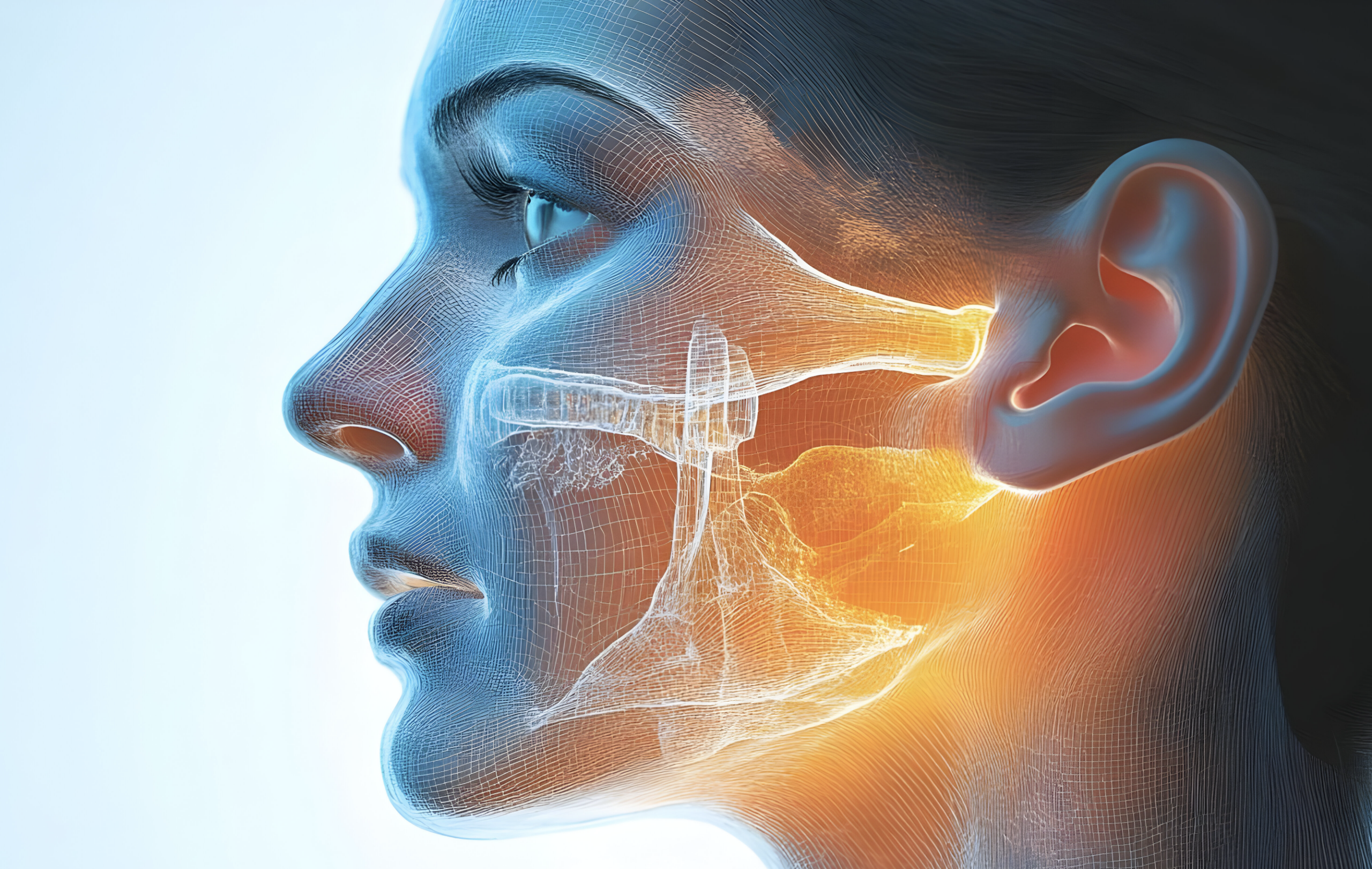
The jaw does not operate in empty space
The mandible moves from a head-and-neck system that is itself moving. Head position can alter muscle length and movement strategy. Pain in one region can create guarding in another. This alone is enough reason to examine the cervical region when the history points in that direction.
Research consistently shows meaningful overlap between TMD and cervical symptoms, including greater neck disability and altered cervical function in many pain-related TMD populations. Cervical and craniocervical rehabilitation can also help selected patients. That supports assessment and treatment of relevant neck dysfunction. It does not prove that every painful jaw began with the neck.
Association is not the same as causation
Clinical stories can be compelling. A patient may have jaw pain along with scoliosis, an old ankle surgery, a limp, shoulder dysfunction or an asymmetrical posture. When several findings line up, it is tempting to draw a straight line from the foot to the jaw. A more careful approach is to draw that line in pencil, not ink.
A lower-limb problem can change gait. Gait can influence trunk movement. Pain can change posture. Growth and anatomy can influence several regions at once. Yet in an individual patient we often cannot prove which variable came first. The safer clinical response is to treat the real findings that matter while staying humble about the arrows between them.
Posture is not a moral judgment
“Bad posture” is an unhelpful phrase. Posture changes with vision, breathing, fatigue, work position, mood, pain, sport, anatomy and environment. Human beings are built to move through many postures. The problem is more often prolonged loading, lack of movement variety, weakness or a painful position that is repeatedly sustained.
For an office worker, sensible changes may include raising the screen, supporting the forearms, changing position frequently, alternating sitting and standing, and learning gentle cervical and scapular exercises. The aim is not to hold the chin rigidly tucked all day. It is to improve comfortable movement options.
A simple ergonomic principle for long sitting
People who spend hours sitting—dentists, surgeons, drivers, students and office workers—can benefit from a basic ergonomic idea: avoid sitting with the body tightly folded. Let the feet rest comfortably, keep the knees and hips in open, supported positions, relax the shoulders, and allow the spine to remain upright without becoming rigid. Movement breaks matter more than chasing a perfect static posture.
When treating outside the jaw can still make sense
Sometimes a patient improves when the rehabilitation programme includes the neck, shoulder or another musculoskeletal problem. That does not prove which part of the programme was the “cure.” If an appliance, exercises, shoulder rehabilitation, reassurance and natural recovery all occur together, the result belongs to the programme—not automatically to one favourite intervention.
When should the feet, gait or spine actually be assessed?
A whole-body assessment is more relevant when the history contains a meaningful reason: a large limb-length discrepancy, major lower-limb surgery, persistent limp, painful gait, longstanding orthotic use, scoliosis, obvious functional asymmetry or a strong relationship between musculoskeletal flares and jaw symptoms. Even then, referral may be more appropriate than treatment by the dentist.
A whole-body approach should make care more interdisciplinary, not make one clinician pretend to be every specialist.
Dizziness and vertigo need restraint
Dizziness has many possible causes, including vestibular disorders, migraine, cardiovascular issues, medication effects, neurological disease and anxiety. TMD and cervical symptoms can coexist with dizziness, but recurrent or new vertigo should not be casually labelled “TMJ-related.” Appropriate ENT, neurological or medical assessment may be necessary.
What “posture correction” should really mean
Useful rehabilitation may aim to reduce painful sustained positions, improve comfortable neck movement, build endurance, restore thoracic mobility, improve breathing and relaxation, reduce jaw bracing and help the patient move with less fear. The programme should be individualised. Exercises that create sharp joint pain, neurological symptoms or progressively worsening limitation need reassessment.
The balanced conclusion
The strongest whole-body relationship relevant to routine TMD care is the overlap between jaw and cervical function, combined with the broader interaction among pain, movement, sleep, stress and daily life. Significant problems elsewhere in the musculoskeletal system can be worth assessing. What we should avoid is advertising a universal ankle-to-knee-to-hip-to-shoulder-to-TMJ sequence as established fact. Curiosity is valuable; certainty should match the evidence.
The complete chapter in Understanding Your TMJ uses real patient stories—including posture, scoliosis, frozen shoulder and lower-limb history—to show where whole-body thinking is useful and where it can become speculation. If your jaw symptoms travel with your neck, shoulder or posture, the book gives you a more nuanced way to ask what actually deserves treatment. Read the full chapter before accepting either extreme: “it is only the jaw” or “everything in the body is causing the jaw.”