
Perhaps you like your smile in conversation but avoid showing your teeth in photographs. Perhaps one chipped tooth attracts all your attention. Before planning a smile treatment trip from Europe to India, give that concern a precise description. “I want this edge repaired” is a more useful starting point than “I want a complete makeover.”
This English-language guide is for people living across Europe, including NRIs visiting India. European countries have different healthcare arrangements, prices and travel requirements. Your own location and clinical needs should guide any comparison.
Tell us what you would like to change about your smile.
Decide what you would like to change
Bring a few natural photographs and point out the details that bother you: colour, shape, a visible gap, uneven edges or the appearance of alignment. Also describe anything you want to keep. A smile should still feel like yours.
Dr Chirag Chamria can assess those goals alongside the condition of your teeth and bite. Aesthetic wishes matter, but they are only part of choosing a treatment that is appropriate for the mouth supporting it.
Case discussion: a fixed smile after missing front teeth
M., a 28-year-old man from India, wanted a fixed replacement for missing upper front teeth. His assessment recorded some loss of supporting bone in the area. The plan combined two implants, pulp treatment of an adjacent tooth and a fixed PMMA restoration for the upper front region.
Treatment took place over two days. At the recorded three-year review, he described greater confidence when smiling. This was implant-supported restorative treatment, rather than veneers or orthodontic movement. The comparison images help show the difference between changing the form of a tooth and replacing a tooth that is absent. Your own smile assessment should make that distinction just as clear.
Before and after
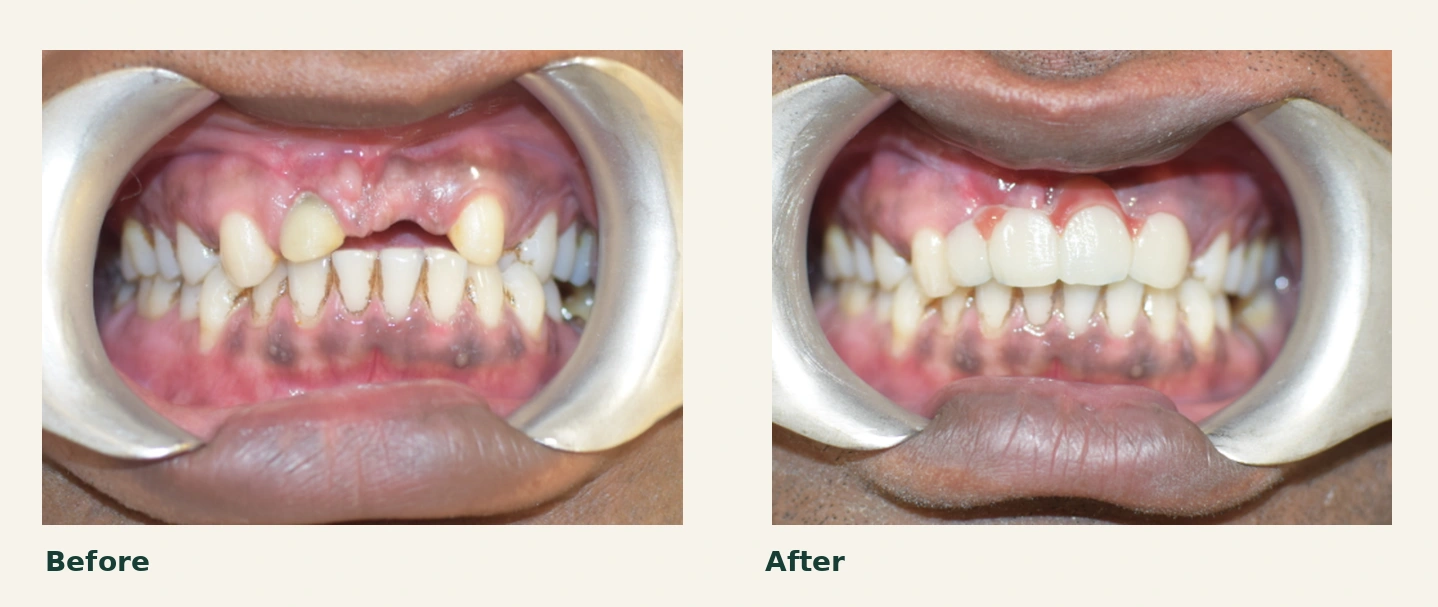
C04 — M., 28, India. Two implants, adjacent-tooth pulp treatment and a fixed PMMA restoration for missing upper front teeth; treatment over two days.
Hear a patient experience
A separate patient experience from the clinic’s public video library.
Explore the right smile approach for your teeth.
Know what the proposed smile treatment plan India
Restorative treatment changes tooth form or covers tooth surfaces; orthodontic treatment physically moves teeth over time. These are different approaches, with different implications for healthy tooth structure and the treatment sequence.
A phrase such as “straighter teeth in a day” needs an explanation. It may describe the appearance achieved with restorations in a suitable case. It should not be understood as teeth being orthodontically moved in one day.
Use the cosmetic dentistry guide to start comparing approaches. If veneers are proposed, read the veneer information and ask why they are suitable for the specific teeth concerned.
Ask to see examples that answer your question
An attractive before-and-after image is most helpful when you know what was done. Was the change made with crowns, veneers, bonding or orthodontics? Were the teeth already damaged? How long after treatment was the photograph taken?
A photograph of crowns should not be used to suggest a veneer result. During your consultation, ask to see examples relevant to your proposed procedure, with an explanation of the treatment and follow-up. That context makes the images more useful when discussing what you hope to change.
Bring the bite into the smile discussion
Dr Chamria's work in oral rehabilitation allows the consultation to consider chewing and tooth support alongside appearance. Tell him about worn teeth, repeated chipping, previous restorations and any discomfort that accompanies your smile concern.
Useful questions include how much preparation is proposed, whether a smaller change is possible, what material is being recommended and how a future repair would be handled. Ask which parts of the appearance can be discussed before treatment starts, and what limitations follow from your own teeth.
Plan a visit around decisions you understand
A trip should leave room for assessment, the agreed treatment stages and checks. Avoid fixing your schedule around an unconfirmed promise that every smile change takes one day. The plan should specify what can realistically be achieved during your stay.
If you are comparing a proposal from your European dentist with one in India, compare the same teeth, procedure and material. Confirm any insurance or reimbursement questions with your own provider rather than assuming overseas care is covered.
How a smile plan develops before treatment begins
The planning appointment starts with photographs, your concerns and an examination of the teeth, gums and bite. Explain which changes you would welcome and which features you would like to preserve. Existing crowns, missing teeth and worn surfaces can affect the choices available.
Dr Chamria can then separate the goals: changing colour, rebuilding a damaged tooth, replacing a missing tooth or physically moving teeth. Ask to see how each proposed procedure serves the particular goal. Discuss any tooth preparation, the proposed material and the limitations that follow from your starting point.
The next step is a written plan covering the teeth involved, treatment stages and estimate. Ask how the intended appearance will be discussed before irreversible work begins and whether any preview is appropriate for your case. If there is a temporary stage or a later restoration, both should be identified.
During treatment, the planned restorations are assessed for appearance, fit and bite. Before returning to Europe, clarify the care instructions, review appointments and future repair arrangements. A consultation is a chance to explore a smile change with enough context to feel comfortable about the decisions behind it.